

The link between learning and economic survival is undeniable. Across developing nations, millions of bright, capable minds remain locked outside the classroom simply because their families struggle to survive. This systemic issue forms a multi-generational trap where lack of learning breeds financial hardship, and financial hardship prevents access to learning. When we examine the deep-rooted crisis of education and poverty in Pakistan, we find that the two forces are inextricably linked, acting as both cause and effect.
For decades, the Ghazali Education Foundation (GEF) has worked directly in the trenches of rural communities to dismantle this barrier. Breaking this cycle requires a deep understanding of why traditional systems fail and how community-driven interventions can carve out a path toward permanent, sustainable change.
The Harsh Reality Of Rural Exclusion
While urban centers feature modern schools and rising literacy rates, the picture changes completely once you step into rural districts. In distant villages across Punjab, Sindh, Balochistan, and Khyber Pakhtunkhwa, going to school is frequently a distant luxury rather than an ordinary childhood milestone.
The True Cost Of Free Schooling
Many people assume that public schools solve the access problem because they do not charge tuition. However, tuition is only a small fraction of the financial burden. Families must still purchase uniform sets, shoes, notebook bundles, pens, and backpacks.
When a household survives on casual daily wages, these minor costs accumulate into an impossible sum. Facing a choice between purchasing a week of household rations or a stack of schoolbooks, a parent will always choose immediate survival.
The Pressure Of Immediate Income
In low-income households, children are frequently seen as vital economic contributors. From a young age, boys are steered toward working in agricultural fields or automotive repair shops, while young girls are kept at home to manage chores or care for younger siblings. The immediate return of a few extra rupees today consistently outweighs the long-term, unseen promise of a school diploma tomorrow.
How Lack Of Schooling Fuels Economic Hardship
The consequences of leaving millions of children unschooled extend far beyond individual literacy statistics. It actively weakens the fabric of the entire country’s economy.
Structural Lack of Opportunities
Without baseline literacy and essential mathematical skills, an adult is permanently shut out from the modern job market. They remain restricted to low-wage manual labor, seasonal farming, or insecure informal jobs. This lack of earning power ensures that they can never build savings, buy assets, or protect their households from economic shocks.
The Transfer of Generational Deprivation
The most tragic aspect of the relationship between education and poverty in Pakistan is how reliably it repeats across generations. An uneducated parent is rarely able to secure the income required to fund their own children’s schooling. Consequently, the children grow up to face the exact same financial limitations as their parents, passing down a legacy of struggle to the next generation.
The Blueprint For Practical Intervention
Overcoming a challenge of this scale demands a complete departure from top-down, generalized approaches. It requires localized, empathetic, and comprehensive strategies designed specifically for the unique realities of rural life.
Bringing Classrooms to the Doorstep
Long commutes are a primary reason rural children drop out of school, particularly young girls. In many conservative rural areas, parents refuse to allow their daughters to walk long distances along isolated roads to reach a school.
GEF solves this problem through its “doorstep education” model. By establishing community-based schools directly inside the villages, the foundation removes physical safety concerns and eliminates commuting expenses.
Total Fee Concessions and Support
To completely neutralize the financial barrier, a successful program must make learning genuinely cost-free. This means providing fully subsidized enrollment, alongside free distributions of textbooks, stationery, and uniforms. When you remove the financial friction point from the equation, parental resistance vanishes, and enrollment rates climb dramatically.
Holistic Support Beyond The Classroom
A child cannot learn effectively on an empty stomach, nor can they study if they are suffering from untreated illnesses. True educational support must look at the overall well-being of the student.
- Nutritional Programs: Distributing nutritious meals and dietary supplements within schools to counter widespread stunting and anemia.
- Basic Healthcare: Organizing regular medical and vision screenings to catch health issues before they cause chronic school absenteeism.
- Family Counseling: Engaging directly with parents to build trust and demonstrate the long-term financial security that an educated child brings to a family.
By looking after the physical health of the student, non-profits ensure that children stay healthy, remain enrolled, and perform at their true academic potential.
Investing In Teachers To Ensure Quality
Access to a classroom matters only if genuine, high-quality learning happens inside it. Many rural areas suffer from a severe shortage of qualified educators, leading to high teacher absenteeism and low student performance.
Recruiting and Training Locally
The most sustainable solution is to recruit educators directly from the local communities. GEF invests heavily in training local young women and men, turning them into skilled, professional teachers. Because these educators live in the very same villages as their students, they possess a deep understanding of the local culture and are profoundly invested in the long-term success of the school.
Building Safe Learning Environments
A proper school must be a space where children feel secure, respected, and inspired. Investing in proper infrastructure, such as clean drinking water facilities, functional toilets, solar power systems, and solid boundary walls, creates an environment where students can focus fully on their growth.
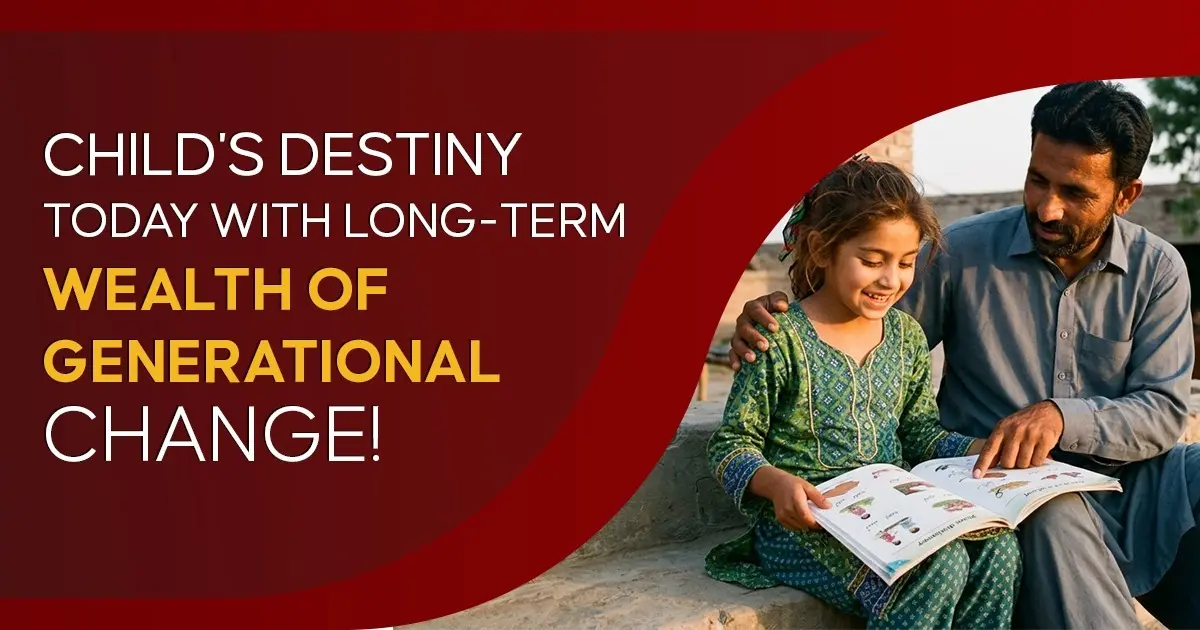
The Long-Term Wealth Of Generational Change
The true return on investment for an educational sponsorship is measured in decades, not months. When you educate a child, you are handing them an economic asset that can never be lost, stolen, or taken away.
An educated young adult gains the tools to secure stable employment, launch small businesses, or pursue higher technical training. As their income grows, they pull their immediate family out of financial hardship. They become independent citizens who naturally prioritize the schooling of their own children, permanently breaking the cycle of lack.
Join Our Circle Of Compassion Today
Reversing the tide of illiteracy is a collective responsibility that requires the unity of the global community. The resources we frequently spend on brief, everyday luxuries possess the power to fund a child’s entire academic year in a remote village.
Whether through regular giving or fulfilling your religious obligations via Zakat and Sadaqah, your support is an investment in human potential. Join our Circle of Compassion today. Your generosity can rewrite the future, replace hardship with hope, and unlock a world of opportunity for a deserving child.
Change a Child’s Destiny Today
Your contribution can break the chains of poverty for a family in rural Pakistan. Provide a student with books, uniforms, and a safe classroom today.